TEL: +86 18903393212
 Email: tina@yintoglassware.com
 TEL: +86 18903393212Email: tina@yintoglassware.com
The global hospitality and specialty coffee sectors are witnessing a significant shift toward high-performance thermal containment, driving a surge in demand for double wall coffee cups wholesale solutions. As consumers prioritize both beverage temperature retention and ergonomic safety, the transition from single-layer vessels to sophisticated vacuum or air-insulated structures has become a baseline requirement for commercial operators.
This evolution is not merely aesthetic; it addresses a critical engineering challenge: the balance between thermal insulation and structural fragility. For wholesalers and cafe owners, the primary difficulty lies in sourcing glassware that offers superior insulation without sacrificing the clarity and purity that only high-quality borosilicate glass can provide, especially when scaled for high-volume commercial use.
This analysis examines the technical specifications of double-wall insulation, the material science behind borosilicate glass, and the procurement frameworks necessary for sourcing durable, professional-grade drinkware. By evaluating the relationship between thermal physics and material durability, we provide a roadmap for optimizing the selection of double wall coffee cups wholesale for diverse commercial environments.


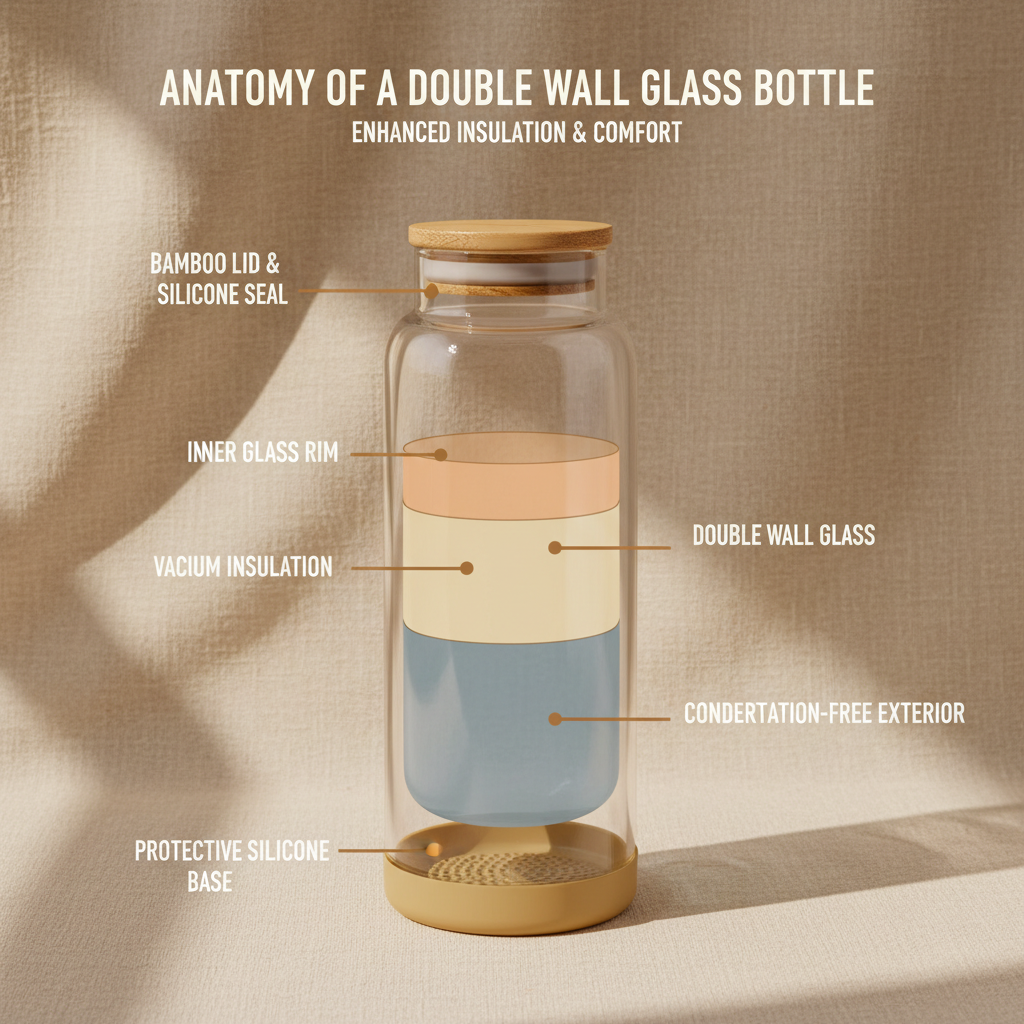
The core principle of double-wall construction is the creation of a stagnant air layer between two concentric glass shells. This layer acts as a thermal barrier, significantly reducing heat transfer via conduction and convection. In the context of double wall coffee cups wholesale, this design ensures that the outer surface remains cool to the touch even when containing boiling liquids.
Technically, this reduces the temperature gradient between the beverage and the external environment, preserving the aromatic profile of the coffee by slowing down the cooling process. The efficiency of this insulation is heavily dependent on the precision of the wall thickness and the quality of the seal at the base of the vessel.
Unlike standard soda-lime glass, borosilicate glass incorporates boron trioxide, which drastically lowers the coefficient of thermal expansion. This allows the glassware to withstand rapid temperature fluctuations—thermal shock—without cracking. This is a critical specification for wholesale buyers who provide products for high-turnover environments where cups may move quickly from a dishwasher to a hot espresso machine.
From an engineering perspective, the chemical stability of borosilicate glass ensures that no metallic or alkaline residues leach into the beverage, preserving the authentic taste of high-end coffee blends. This neutrality is what makes it the preferred material for professional drinkingware series and laboratory equipment alike.
The transparency of the material also allows for a visual "floating" effect of the liquid, which adds a premium aesthetic value to the product. When sourcing these items, verifying the boron content and the annealing process is essential to ensure long-term durability against mechanical stress.
The most vulnerable point of any double-walled vessel is the junction where the inner and outer walls meet. Improper sealing can lead to vacuum failure or the ingress of moisture, which destroys the insulating properties and creates unsightly condensation.
Furthermore, the distribution of wall thickness must be uniform. Any localized thinning in the glass structure creates a stress concentrator, making the cup susceptible to breakage upon impact. High-quality production cycles involve rigorous annealing to remove internal stresses, ensuring that the final product can withstand the rigors of commercial handling.
Evaluating the effectiveness of double-wall insulation requires a comparison of heat loss rates across different material configurations. While the primary goal is to maintain the internal liquid temperature, the secondary goal is to maintain a safe exterior temperature for the user.
The following assessment illustrates the relative performance of various glass wall configurations based on normalized thermal retention scores.
In a high-volume cafe environment, the deployment of double-wall glassware focuses on the user experience of "slow sipping." By reducing the heat transfer rate, customers can enjoy their beverages over a longer period, which is particularly valuable for pour-over coffee or specialty lattes that are served at precise temperatures.
From an operational standpoint, the use of these vessels reduces the reliance on cardboard sleeves, aligning with sustainability goals while maintaining a high-end brand image. When choosing double wall coffee cups wholesale, operators must consider the storage density and stackability to optimize behind-the-counter workspace.
The next generation of double-wall glassware is moving toward hybrid material integration. We are seeing research into combining borosilicate glass with reinforced polymer bases to increase impact resistance—the primary weakness of all-glass systems. This allows for a more durable "commercial-proof" vessel that retains the purity of glass.
Additionally, advances in automated precision molding are reducing the wall thickness of the outer shell without compromising strength. This results in a lighter product that is easier to handle in large quantities, reducing fatigue for service staff in busy dining environments.
Sustainability is also driving the adoption of recycled borosilicate content. The industry challenge lies in maintaining the same level of transparency and thermal shock resistance while incorporating post-industrial glass waste, a trend that is becoming a key requirement for European and North American wholesale buyers.
When evaluating double wall coffee cups wholesale, procurement managers should not focus solely on price per unit. The total cost of ownership includes the breakage rate over a 12-month cycle and the consistency of the thermal seal.
A rigorous selection process involves testing the vessels against rapid temperature changes and assessing the ergonomics of the grip. The following matrix provides an evaluation framework for different configuration profiles.
By aligning the configuration type with the specific needs of the application, buyers can maximize the ROI of their drinkware investment.
| Configuration Type | Thermal Retention | Impact Resistance | Recommended Use Case |
|---|---|---|---|
| Basic Double Wall | Moderate | Low | Low-volume Boutique Cafes |
| Standard Borosilicate | High | Moderate | Standard Commercial Service |
| High-Duty Reinforced | High | High | High-traffic Fast Casual |
| Precision Vacuum | Extreme | Moderate | Premium Tasting Rooms |
| Lightweight Slim-Wall | Moderate | Low | Event Catering / Pop-ups |
| Industry Baseline | Moderate | Moderate | General Hospitality Use |
The primary advantage is the significantly lower coefficient of thermal expansion. Borosilicate glass can withstand extreme temperature shifts—such as moving from a refrigerator to containing boiling water—without the internal stress causing a fracture. For wholesale buyers, this translates to a lower breakage rate and longer product lifespan in commercial environments.
Double-wall construction does not directly alter the flavor, but it preserves the temperature of the liquid for longer. This is crucial for specialty coffees where the flavor profile changes as the beverage cools. By slowing the heat loss, the intended taste and aroma are maintained for a longer duration of the drinking experience.
Condensation inside the walls occurs when the airtight seal at the bottom of the cup fails. This allows moisture-laden air to enter the insulating gap. When a cold liquid is added, the moisture condenses on the inner wall. High-quality wholesale products utilize precision fusion to ensure a permanent, hermetic seal that prevents this failure.
Most professional borosilicate double-wall glasses are dishwasher safe. However, the high-pressure jets and extreme heat cycles of industrial dishwashers can stress the seals over time. It is recommended to use a gentle cycle and avoid stacking them too tightly in the racks to prevent mechanical chipping.
Buyers should request data on the material's thermal shock resistance and the supplier's quality control process for seal integrity. A reputable supplier will provide certifications for the borosilicate content and samples that can be stress-tested. Checking the uniformity of the wall thickness is also a key indicator of production quality.
Yes, pure borosilicate glass is generally microwave safe. However, buyers must ensure there are no metallic accents or paints on the glass. The double-wall structure does not interfere with microwave heating, but as with all glassware, avoid extreme temperature jumps immediately after removing them from the microwave.
The transition toward double-wall borosilicate glassware represents a convergence of thermal physics and consumer demand for premium experiences. By effectively decoupling the beverage temperature from the exterior surface, these vessels solve the dual problem of heat loss and user safety. The finding is clear: the durability of the thermal seal is the single most important factor in determining the commercial viability of the product.
For businesses scaling their operations, the practical implication is a move away from commodity glassware toward technically specified borosilicate solutions. Investing in high-performance double wall coffee cups wholesale not only enhances the customer's sensory experience but also reduces long-term operational waste through superior material resilience.